
Polite Follow-Up Email Sample for a Request: 15+ Templates That Get a Response
You asked for something and heard nothing back. Now you need to follow up — without sounding pushy, needy, or annoyed. This guide gives you 15+ polite follow-up email samples for a request, sorted by situation, plus the simple structure and timing that make people actually reply. Copy, tweak, and send.
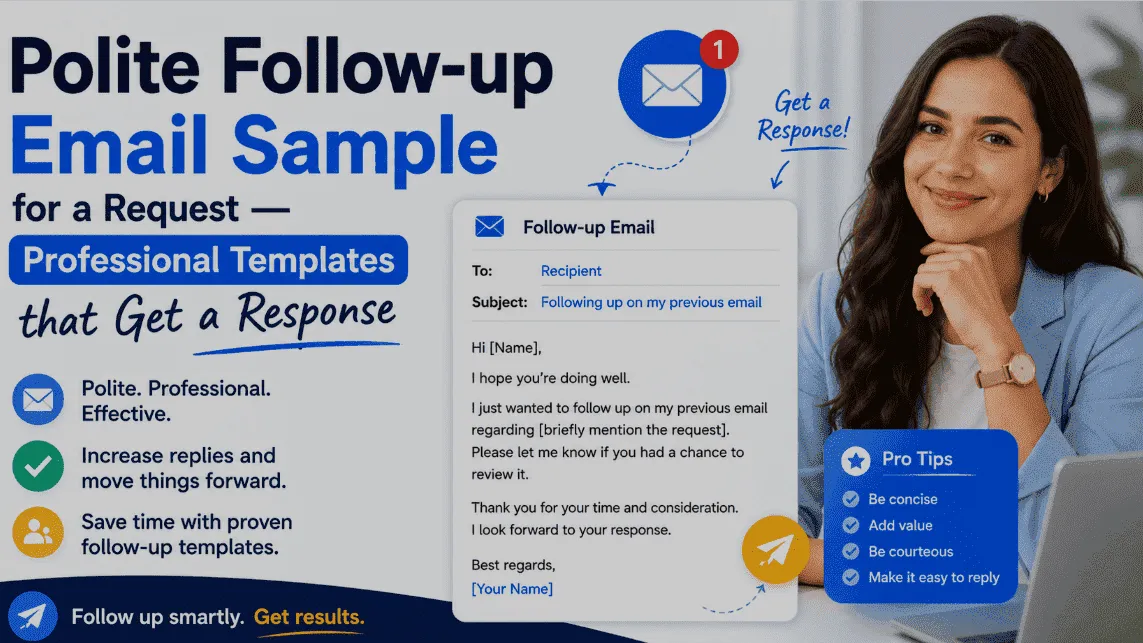
A polite follow-up email does three things: it gently reminds without guilt-tripping, it restates the request so the reader doesn’t have to dig, and it makes replying easy with a clear, low-pressure ask. Keep it short, lead with warmth, and end with gratitude — data shows emails that close with a thank-you get noticeably more replies. Wait about 3–5 business days before the first follow-up, and space out any further ones. Below are 15+ copy-paste samples for every situation.
Following up is one of those small professional skills that quietly separates the people who get things done from the people who get left on read. Because here’s the reality: most non-responses aren’t rejections. Your email got buried under 120 others, the person meant to reply and forgot, or they were waiting on something themselves and it slipped. Silence usually isn’t “no” — it’s “not yet.” A good follow-up is simply a gentle, considerate nudge back to the top of their inbox.
The problem is that follow-ups are genuinely easy to get wrong. Push too hard and you sound demanding. Apologize too much and you sound unsure of yourself. Wait too long and the moment passes; follow up too soon and you seem impatient. Strike a passive-aggressive note — “per my last email” with an edge — and you damage the relationship you’re trying to use.
The good news is that a polite, effective follow-up follows a simple, repeatable pattern. Once you know it, you can write one for any situation in a couple of minutes — and this guide hands you ready-made samples for all of them. Let’s start with what makes a follow-up work.
The 5-Part Structure of a Polite Follow-Up
Before the templates, understand the anatomy — because once you know the five pieces, you can adapt any sample to your exact situation. A polite, effective follow-up email has these parts:
That’s the whole formula: warm opener, context, clear ask, easy out, grateful close — kept short. Every sample below is built on it. Copy whichever fits and swap in your details.
When Should You Send a Follow-Up? (Timing Guide)
Timing matters almost as much as wording. Too soon and you seem impatient; too late and the momentum is gone. Here’s a sensible rhythm for following up on a request.
| Follow-up | When to send | Tone |
|---|---|---|
| First follow-up | 3–5 business days after the original | Warm, light, assume good intent |
| Second follow-up | About a week after the first | Still polite, slightly more direct |
| Third / final follow-up | 1–2 weeks after the second | Gracious “closing the loop” note |
| Time-sensitive request | 1–2 business days, referencing the deadline | Polite but clear about urgency |
A few timing principles: give people a couple of business days minimum before the first nudge (everyone deserves a reasonable window), avoid following up on the same day or first thing the next morning unless it’s genuinely urgent, and know when to stop — after three well-spaced, polite attempts with no reply, it’s usually best to let it rest or find another channel rather than keep emailing.
General Request Follow-Up Samples
These all-purpose samples work for the most common situation: you asked for something, and you’re following up politely. Start here if you’re not sure which category fits.
Hi [Name],
Just floating this back to the top of your inbox in case it slipped by — I know how busy things get. When you have a moment, could you let me know your thoughts on [the request] from [day/date]?
No rush if you need a little more time. Thanks so much!
Best,
[Your name]
Hi [Name],
I wanted to follow up on my email from [date] regarding [request]. Would you be able to share an update when you get a chance?
Happy to provide anything else you might need from my end. Thank you!
Best regards,
[Your name]
Hi [Name],
Circling back on [request] — I know your plate is full. If it’s easier to talk it through than to write back, I’m happy to hop on a quick 10-minute call this week. Otherwise, a short reply whenever suits you is perfect.
Thanks for your help,
[Your name]
Gentle First-Reminder Samples
When you want the softest possible touch — a new contact, a senior person, or a favor rather than an obligation — these lead with extra warmth and zero pressure.
Hi [Name],
I hope you’re having a good week! I don’t want to be a bother — just wanted to gently follow up on [request] in case my earlier note got buried. Absolutely no urgency; I know these things take time.
Whenever you have a spare moment, I’d be grateful for your thoughts. Thank you!
Warm regards,
[Your name]
Hi [Name],
Thanks again for considering [request] — I really appreciate you taking the time. Just checking in to see if you’d had a chance to think it over. Completely understand if you need more time or if it’s not the right fit.
Either way, thank you so much for your consideration.
Best,
[Your name]
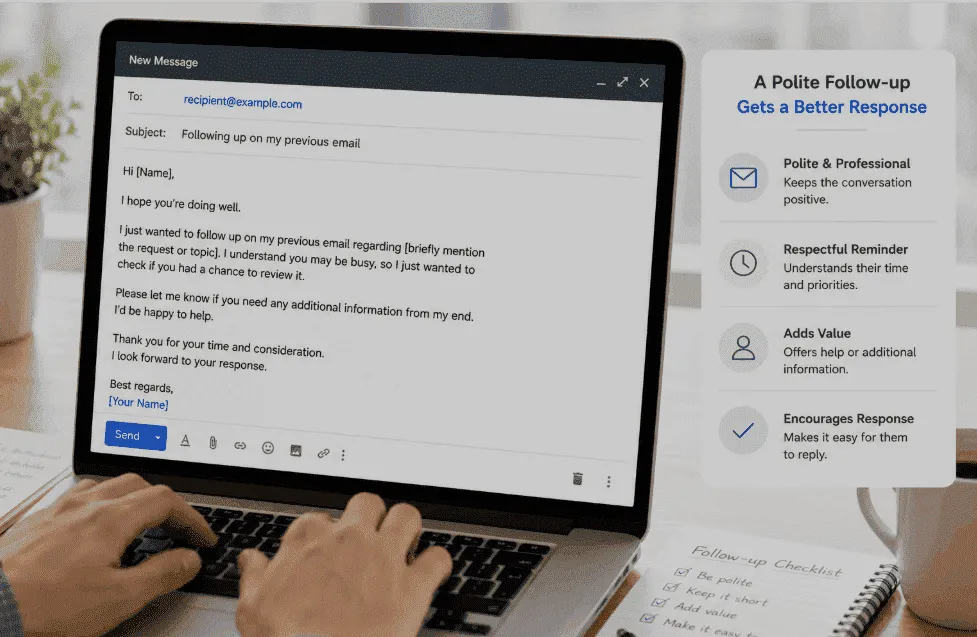
Second & Third Follow-Up Samples
Still no reply after your first nudge? A second (and, if needed, final) follow-up is completely appropriate — the key is to stay polite while being a touch more direct, and to give a graceful exit on the last one.
Hi [Name],
I know how easily things pile up, so I wanted to check in once more on [request]. It would really help me to [brief reason it matters — e.g. “move forward with the project” / “confirm the timeline”].
Could you let me know if this is something you’re able to help with? Even a quick yes/no would be a great help. Thanks so much for your time.
Best,
[Your name]
Hi [Name],
I don’t want to keep cluttering your inbox, so this will be my last note on [request]. If now isn’t the right time, I completely understand — just let me know and I’ll follow up again down the line, or feel free to reach out whenever it works for you.
Thanks again for your time, and no hard feelings either way!
Best regards,
[Your name]
Follow-Up Samples for Specific Situations
Different requests call for slightly different framing. Here are ready-to-use samples for the situations people most often need to follow up on.
Dear [Hiring Manager’s name],
I hope you’re well. I’m writing to follow up on my application for the [Job Title] role, submitted on [date]. I remain very enthusiastic about the opportunity to contribute to [Company], and I’d welcome the chance to discuss how my experience fits the position.
Please let me know if you need anything further from me. Thank you for your time and consideration.
Best regards,
[Your name]
Hi [Name],
Thanks again for taking the time to chat on [day]. I really enjoyed the discussion about [topic]. As a next step, you mentioned [action] — I wanted to check in on where that stands and whether there’s anything you need from me to keep things moving.
Looking forward to hearing from you. Thanks!
Best,
[Your name]
Hi [Name],
Just following up on the [document/information] I asked about on [date] — I’d like to [reason, e.g. “finalize the report by Friday”]. Would you be able to send it across when you get a moment?
If it’s easier, I’m happy to jump on a quick call. Thanks so much for your help!
Best,
[Your name]
Hi [Name],
I hope you’ve had a chance to review the proposal I sent on [date]. I’d love to hear your thoughts and answer any questions that have come up. If it would help, I’m glad to walk through it together on a short call this week.
No pressure at all on timing — just let me know how you’d like to proceed. Thank you!
Best regards,
[Your name]
Hi [Name],
I hope all’s well. This is a gentle reminder that invoice [#], sent on [date], is now due. If it’s already in process, please disregard this note with my thanks. If not, I’d appreciate it being settled at your earliest convenience.
Happy to resend the invoice or answer any questions. Thank you!
Best,
[Your name]
Hi [Name],
I know I reached out about [request] recently, and I completely understand if it’s not something you’re able to help with right now. I just wanted to check in once, gently, in case it got lost in the shuffle.
Truly no pressure — I value our relationship regardless. Thanks so much!
Warmly,
[Your name]
Subject Lines That Get Follow-Ups Opened
Your follow-up’s subject line decides whether it gets opened at all. These patterns work because they’re clear, honest, and easy to act on.
A polite follow-up lands better when the whole email is clean — a clear subject, a warm tone, and a professional signature with your name and contact details. Our email etiquette guide covers the habits that make your emails consistently polished and reply-worthy.
Follow-Up Mistakes That Kill Your Reply Rate
Even a well-timed follow-up can flop if it falls into one of these traps. Avoid them and your replies will climb.
Frequently Asked Questions
A polite follow-up email follows a simple five-part structure: open with a warm, low-pressure line that acknowledges the person is busy; give a one-line reminder of what you asked and when; restate your request specifically so it’s easy to act on; offer an easy out or alternative (“no rush” or “happy to jump on a quick call”); and close with genuine gratitude. Keep the whole thing shorter than your original email. For example: “Hi [Name], just floating this back to the top of your inbox in case it slipped by. When you have a moment, could you share your thoughts on [request]? No rush at all — thanks so much!”
For most requests, wait 3–5 business days after your original email before the first follow-up — this gives the person a reasonable window without seeming impatient. Space a second follow-up about a week after the first, and any final follow-up 1–2 weeks after that. For genuinely time-sensitive requests, it’s fine to follow up within 1–2 business days, as long as you reference the deadline politely. Avoid following up the same day or first thing the next morning unless it’s urgent, and cap it at about three well-spaced attempts before letting it rest or trying another channel.
The secret is to assume good intent and lower the pressure. Lead with warmth (“I know how busy things get”), avoid any phrasing that sounds like a dig (skip “per my last email”), and explicitly give an easy out (“no rush if you need more time” or “completely understand if it’s not the right fit”). Counterintuitively, reducing pressure tends to increase replies, because people respond better when they don’t feel cornered. Keep it short, restate your request clearly so replying is effortless, and always close with a genuine thank-you. That combination reads as considerate, never pushy.
Generally, up to three polite, well-spaced follow-ups is the ceiling. A typical sequence is: a gentle first nudge 3–5 business days after the original, a slightly more direct second follow-up about a week later, and a gracious “closing the loop” note 1–2 weeks after that. If you’ve sent all three and still heard nothing, it’s best to stop emailing — continuing risks damaging the relationship and rarely helps. At that point, consider a different channel (a phone call or a mutual contact) or simply revisit the request later. Persistence is professional; pestering is not.
The best follow-up subject lines are clear, honest, and signal low effort to reply. Strong options include “Following up: [request],” “Quick follow-up on [topic],” “Checking in on [request],” and “Gentle nudge: [request].” Replying within the original thread with “Re: [original subject]” is also excellent because it keeps all the context one click away. Avoid vague subjects like “Hi” or “Question,” and steer clear of anything that sounds urgent or demanding unless the matter genuinely is time-sensitive. The word “quick” is quietly effective — it tells the reader this won’t take much of their time.
In most cases, replying within the original email thread is best. It keeps all the context together, so the recipient can see exactly what you asked without hunting for it, and the “Re:” subject line signals continuity. Start a fresh email only if the original thread has become very long and cluttered, if significant time has passed and a clean slate feels more appropriate, or if you want a new subject line to catch attention. When you do reply in-thread, still include a brief one-line reminder of your request at the top rather than assuming they’ll scroll down to find it.
Yes. An analysis by the email company Boomerang of over 350,000 email threads found that emails closing with a variation of “thank you” received noticeably more responses than those that didn’t — “thanks in advance” led with a 65.7% response rate versus a 47.5% average. Gratitude works because it’s warm, polite, and subtly signals that you’re expecting the person to follow through. In a follow-up specifically, a grateful close also softens the reminder and leaves a positive final impression. It’s a small touch that measurably improves your odds of hearing back.
The Bottom Line
A polite follow-up email isn’t about being persistent for its own sake — it’s about making it easy and pleasant for someone to give you what you asked for. Remember that silence usually means “not yet,” not “no.” A warm, brief, well-timed nudge that restates your request and lowers the pressure will get you a reply far more often than either staying silent or pushing hard.
Pick the sample above that fits your situation, keep it short, wait a sensible few days, and end with a genuine thank-you. Do that, and following up stops being awkward — it becomes one of the simplest, most reliable ways to move your requests forward and keep your professional relationships warm.