
Interesting Email Sign-Offs: 120+ Ways to End an Email That People Actually Remember
Almost everyone defaults to “Best regards” — which is exactly why it disappears the moment someone reads it. This is the complete guide to more interesting ways to sign off an email: over 120 closings sorted by situation, the psychology of why the last line matters, real data on which ones get more replies, and the mistakes that quietly make you look bad.
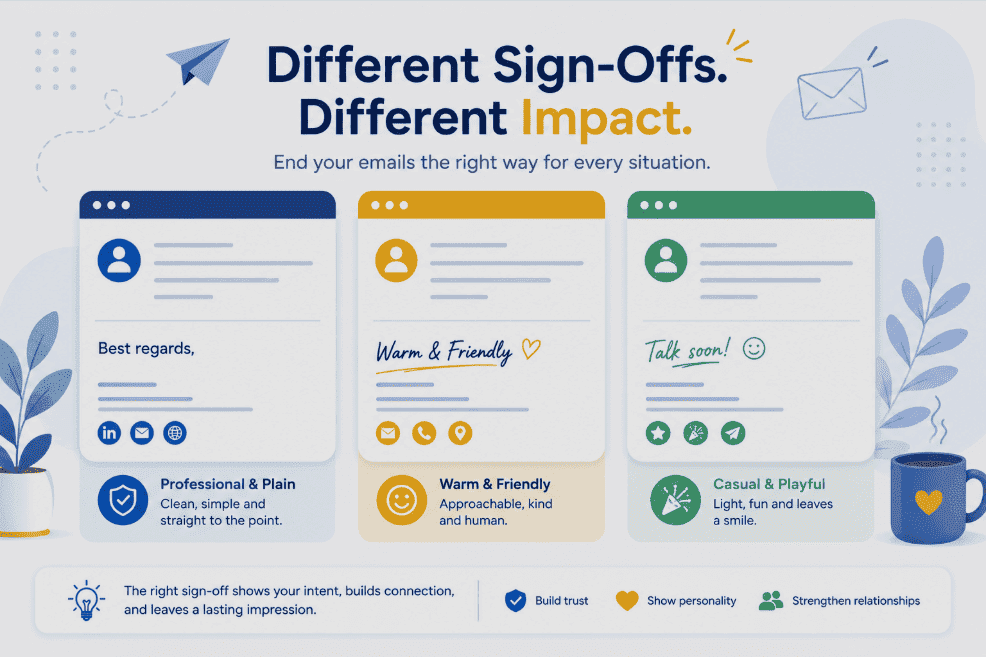
An interesting email sign-off does two jobs at once: it fits the situation and it sounds like a real human wrote it. For most professional emails, a warm-but-simple close works best — and if you want a reply, gratitude wins (emails ending in a variation of “thanks” measurably outperform everything else). Save the creative and funny sign-offs for people who already know your personality. Below you’ll find 120+ options sorted exactly by when to use them.
Here’s a small experiment. Scroll back through the last twenty emails in your inbox and try to remember how a single one of them ended. You can’t, can you? They almost all closed with “Best,” “Regards,” or “Thanks” — the beige carpet of email endings. Perfectly fine. Utterly forgettable.
And that’s the opportunity. The sign-off is the last thing a person reads before they decide how they feel about your message and whether they’re going to reply. It’s your final impression, your parting handshake, the tone you leave hanging in the air after the words stop. Yet most of us treat it as an afterthought — something our email client fills in automatically while our brain has already moved on to the next task.
The good news is that ending an email in a more interesting way isn’t about being clever or quirky for its own sake. Often it’s just about being a little more intentional, a little warmer, a little more matched to the actual human on the other end. This guide gives you every option — from the quietly effective to the genuinely creative — organized so you can find the perfect close for whatever you’re writing right now. Let’s start with why any of this matters.
Why Your Email Sign-Off Actually Matters
It’s tempting to dismiss the sign-off as pure formality. But there’s real psychology — and real data — behind why that last line punches above its weight.
Start with a quirk of memory called the recency effect. Our brains disproportionately remember the first and last things in any sequence, and forget the middle. In an email, that means your opening line and your closing carry more weight in the reader’s memory than everything sandwiched between them. A flat, careless sign-off wastes one of the two most memorable moments you get.
Then there’s the data, and this is the part that should change how you think. Email scheduling company Boomerang analyzed more than 350,000 email threads to see which closings actually got replies. The finding was striking: emails that ended with a variation of “thank you” got meaningfully more responses than those that didn’t. “Thanks in advance” led the pack with a 65.7% response rate, compared to a 47.5% average across all emails. In other words, simply ending with gratitude lifted reply rates by nearly twenty percentage points. Your sign-off isn’t just etiquette — it measurably affects whether people write back.
There’s a subtler layer too, something worth calling tone-setting. Your sign-off is the emotional punctuation on the whole message. The exact same email body reads completely differently depending on how it ends. Close with “Warmly,” and the reader feels a person behind the words. Close with a curt “Regards,” (no “Best” in front — which, as more than a few people online will tell you, has quietly become code for irritation) and the same message suddenly feels cold, even passive-aggressive. The words above didn’t change. The feeling did.
And finally, the sign-off is a small but genuine signal of effort. When you take two extra seconds to choose a closing that fits the person and the moment, it shows. It says you saw them as an individual rather than an inbox to be processed. In a world where most emails feel like they could have been generated by a machine from a one-line prompt, that flicker of humanity stands out more than ever.
The Anatomy of a Good Email Closing
Before we get to the lists, it helps to understand what a complete email closing is actually made of. Most people think of the sign-off as just one word before their name, but a well-built ending usually has three parts working together:
You don’t need all three in every email — a quick reply to a colleague might just be “Thanks, Alex.” But understanding the structure helps you dial the formality up or down deliberately. And when it comes to choosing the sign-off phrase itself, three questions decide almost everything:
- What’s your goal? Asking for something leans toward gratitude (“Thanks in advance”). Sharing information leans neutral (“Best”). Wanting a reply leans toward a gentle prompt (“Looking forward to your thoughts”).
- What’s your relationship? A brand-new contact gets a safer, more formal close. A teammate you message daily can get something relaxed or even playful.
- What’s the tone of the email? The sign-off should match the message. A creative, cheerful close on top of bad news reads as tone-deaf; a stiff “Respectfully” on a friendly note feels oddly cold.
Keep those three in mind and you’ll rarely pick a wrong one. Now — the sign-offs themselves, sorted so you can jump straight to the category you need.
Professional & Polished Sign-Offs
These are your reliable, credibility-preserving closings — right for clients, senior contacts, formal correspondence, and any situation where you want to look competent and respectful. They’re not exciting, and they’re not meant to be. They’re the ones you reach for when getting it wrong costs more than getting it interesting.
Warm & Friendly Sign-Offs
When the relationship allows a little more humanity — regular colleagues, familiar clients, collaborators you genuinely like — these closings add warmth without tipping into unprofessional. They’re the sweet spot for the majority of day-to-day emails between people who know each other.
Gratitude Sign-Offs (The Ones That Get Replies)
Remember the Boomerang data — closings built on gratitude measurably outperform everything else for getting a response. If your email contains any kind of ask, or you simply want to maximize your odds of hearing back, reach for one of these. They work because gratitude is warm, it’s polite, and it subtly signals that you’re expecting the person to follow through.
Creative & Memorable Sign-Offs
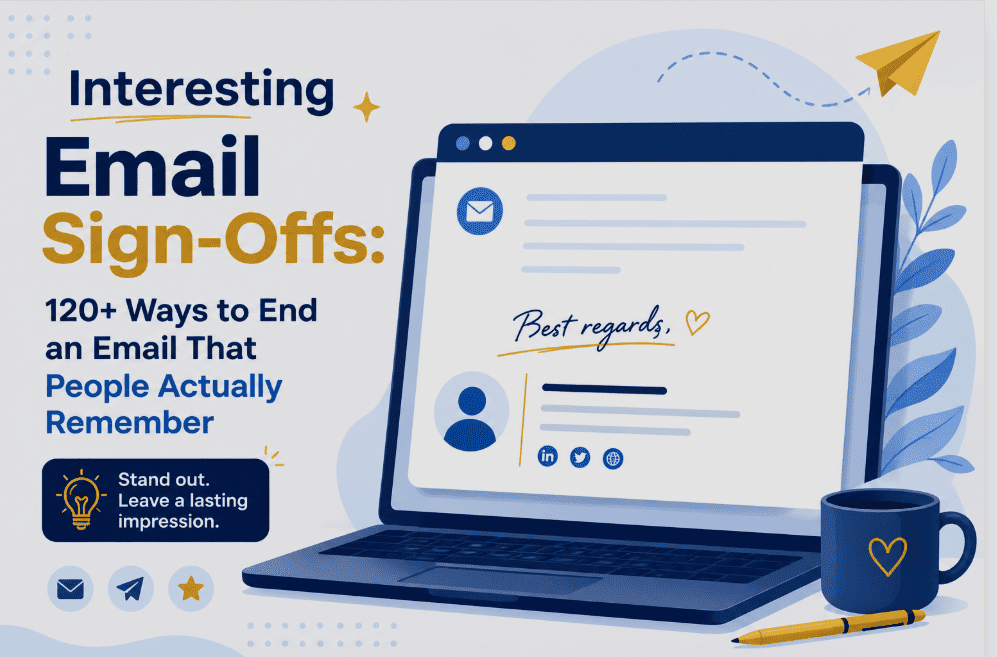
This is where things get interesting — and where you need to read the room. A creative sign-off can make your email genuinely memorable and inject real personality, but it carries more risk than a safe standard. The rule of thumb: use these with people who already know your voice, in industries and moments where a little flair fits. Land it well and you’re memorable; misjudge it and you’re just the person who signed a budget-cut email with “Onward and upward!”
Before you send something quirky, run through these four questions. If any answer gives you pause, fall back to a safe close.
Funny & Casual Sign-Offs
Humor in a sign-off can be a real connector — it makes people smile, builds rapport, and reminds the reader there’s a human on the other end. But it’s the highest-risk category of all, and the guardrails matter. These belong with work friends, familiar teammates, and clients whose sense of humor you genuinely know. When in doubt, leave them out — a joke that lands with your desk neighbor can read as bizarre to a stranger.
Industry-Specific Sign-Offs
One of the smartest ways to make a sign-off feel intentional is to tailor it to your field. An industry-appropriate close does double duty: it adds personality and quietly signals that you understand the world your reader lives in. Here are closings that fit naturally within specific industries.
| Industry / role | Sign-off | Why it fits |
|---|---|---|
| SaaS & startups | Keep scaling, | Speaks the language of growth-focused founders and teams. |
| Finance & advisory | To your financial success, | Client-outcome focused, fitting for advisors and consultants. |
| Cybersecurity & IT | Stay secure, | On-brand and relevant for security-minded recipients. |
| Tech & R&D | Keep innovating, | Reinforces a culture of building and experimentation. |
| Healthcare & wellness | Stay healthy, | Warm and appropriate for health-focused communication. |
| Design & creative | Stay creative, | Fits agencies, studios, and content teams naturally. |
| Email & marketing | To higher deliverability, | An insider nod that marketers immediately recognize. |
| Education & coaching | Keep learning, | Aligns with a growth and development mindset. |
| Construction & trades | Build well, | Grounded and relevant to the work itself. |
| Fitness & sport | Stay strong, | Energetic and on-theme for the audience. |
| 3D printing / makers | Happy printing, | A genuine industry-standard close that builds rapport. |
| Nonprofit & mission-driven | In solidarity, | Reinforces shared purpose and values. |
The beauty of an industry sign-off is that it never feels forced when it’s genuinely yours. If “Happy printing” is what your whole niche says, it builds instant rapport. If it’s not, don’t borrow it — pick something that fits your actual world.
Situation-Based Sign-Offs: The Right Close for the Moment
Sometimes the best sign-off has less to do with formality or personality and everything to do with the specific situation you’re writing into. Here’s a quick-reference guide to the closings that fit particular moments — the ones that feel exactly right because they match what’s actually happening.
| Situation | Try this sign-off | Why it works |
|---|---|---|
| You want a reply | Looking forward to your thoughts, | Politely sets the expectation of a response without pressure. |
| You’ve just scheduled a call | Talk soon, | Accurate and warm — you genuinely will be talking soon. |
| Applying for a job | Thank you for your consideration, | Professional gratitude that fits the application context perfectly. |
| Following up after silence | No rush — whenever suits you, | Lowers the pressure, which paradoxically makes a reply more likely. |
| Someone did you a favor | Thanks again, I owe you one, | Warm, specific gratitude that acknowledges their effort. |
| Sending bad or difficult news | With sincere regards, | Respectful and steady — never jokey or falsely upbeat. |
| Congratulating someone | Congratulations again, | Keeps the focus on their achievement, warmly. |
| Ending a long email thread | Thanks for seeing this through, | Acknowledges the back-and-forth and closes it graciously. |
| Reconnecting after a while | Great to be back in touch, | Warm, them-focused, and reminds them of the connection. |
| Wishing before a holiday/weekend | Enjoy the long weekend, | Personal and timely — shows you’re paying attention. |
Even the most interesting sign-off falls flat above a messy or missing signature. A clean, consistent email signature — your name, role, and contact details, formatted properly on every device — is what makes the whole close look polished. If you manage a team, our guide to the best email signature software in 2026 covers the tools that keep every employee’s signature on-brand automatically.
Sign-Offs to Avoid (and What They Signal)
Just as the right close lifts an email, the wrong one quietly undermines it. Some sign-offs read as careless, cold, or unintentionally rude — often without the sender realizing. Here are the ones to think twice about.
Frequently Asked Questions
There’s no single “most interesting” sign-off, because the best one depends entirely on your relationship with the reader and the tone of your message. That said, the closings that consistently feel interesting without being risky are the warm, slightly personal ones — “Warmly,” “Rooting for you,” “Make it a good one,” or an industry-specific close like “Keep building” or “Stay curious.” They stand out from the endless “Best regards” wall while still sounding like a real, professional human. For maximum memorability with minimum risk, tailor the sign-off to something you genuinely know about the person or their world.
Interesting professional sign-offs keep credibility intact while adding a spark of personality. Good options include “With appreciation,” “Warm regards,” “All the best,” “To your success,” and “Looking forward to what’s next.” If you want something a little more distinctive but still safe, industry-tailored closes work beautifully — “Keep innovating” for tech, “Stay secure” for cybersecurity, “To your financial success” for finance. The key is that the sign-off should feel intentional and matched to the reader, not random. Anything warm, specific, and appropriate to your field will read as more interesting than a default “Regards.”
According to a Boomerang study of over 350,000 email threads, sign-offs based on gratitude get the most responses. “Thanks in advance” performed best with a 65.7% response rate, compared to a 47.5% average across all emails — meaning a grateful closing lifted reply rates by nearly twenty percentage points. Other strong performers were “Thanks” and “Thank you.” The takeaway is simple: if getting a reply matters, end your email with genuine gratitude. It’s warm, polite, and subtly signals that you’re expecting the person to follow through.
Not at all — “Best regards” remains the safest, most reliable professional sign-off, and it fits nearly every business context. It’s not outdated; it’s just neutral. The only “downside” is that it’s so common it doesn’t make you memorable. If you want to stand out, you don’t need to abandon “Best regards” entirely — just swap in something warmer or more tailored when the relationship and situation allow. Use “Best regards” as your safe default for formal or first-contact emails, and reach for more interesting closings with people you know.
They’re not inherently unprofessional, but they are context-dependent. A creative or funny sign-off can build rapport and make you memorable — but only with the right audience and topic. Use them with colleagues and clients who already know your personality, in industries where a little flair fits, and never on a serious or negative message. Interestingly, research on workplace humor suggests it can strengthen team culture and even rapport, so a well-judged funny close among people who know you is often a plus. The rule is simple: know your audience, match the tone, and when in doubt, play it safe.
They’re two different things that work together. The sign-off (or valediction) is the closing phrase — “Best,” “Warmly,” “Thanks” — that comes right before your name. The email signature is the block of information below your name: your full name, job title, company, phone number, website, and sometimes a logo or social links. The sign-off sets the emotional tone of your closing; the signature provides the practical contact details. A polished email has both — an appropriate sign-off and a clean, consistent signature — working in tandem.
Generally, yes. Your first email to someone — especially a new professional contact — should use a safer, slightly more formal close like “Best regards” or “Kind regards,” because you don’t yet know their style. As the conversation develops and you get a feel for their tone, you can relax into something warmer or more personal. It’s also natural to drop the sign-off almost entirely in a fast back-and-forth thread that’s already underway — a quick “Thanks, Sam” is fine once you’re several replies deep. Let the relationship and the rhythm of the exchange guide how formal to be.
For a brand-new email or the first message in a thread, no — skipping the sign-off makes it feel abrupt and slightly cold, like ending a conversation by simply walking away. A one-line closing adds noticeable warmth for very little effort. The exception is a rapid ongoing exchange where you’re already several messages deep with someone; there, dropping the formal close and just signing your name (or nothing at all) reads as natural efficiency rather than rudeness. But as a default, especially with anyone you don’t know well, always include a proper sign-off.
The Last Word on Last Words
Your email sign-off is a tiny thing that does a surprisingly large job. It’s your final impression, the emotional note your message leaves behind, and — as the data shows — a genuine factor in whether people write back. Yet almost everyone leaves it on autopilot.
You don’t have to. The next time you reach the end of an email, take the two seconds to ask: who is this person, and what tone do I want to leave them with? Sometimes the answer is a safe, professional “Best regards.” Sometimes it’s a warm “Rooting for you,” a grateful “Thanks so much,” or an industry wink that makes them smile. The point isn’t to be clever every time — it’s to be intentional. And in an inbox full of forgettable endings, intentional is what people remember.